California Uber & Lyft accident lawyers at Megeredchian Law stand out from the rest because of their expertise, aggressive representation, and encyclopedic knowledge of the law. But there’s one more reason: we cover virtually every aspect of rideshare accident claims. We fight for maximum compensation for passengers, motorists, Uber and Lyft drivers, and even those injured in accidents involving Uber Eats, DoorDash, and similar delivery services.
Hiring a rideshare accident lawyer can significantly increase your chances of recovering full compensation rather than just a fraction—or nothing at all. You may be able to recover medical expenses, lost wages, vehicle repair or replacement costs, pain and suffering, and more. Call Megeredchian Law at (866) 359-0807 to schedule a free consultation.
What Should I Do After a Rideshare Accident?
Rideshare accidents can be confusing because multiple parties, insurance policies, and app statuses may be involved. Whether you were riding in an Uber or Lyft, driving your own vehicle, walking as a pedestrian, or working as a driver on a delivery app, the steps you take immediately after the crash can directly affect your ability to recover compensation.
Below are practical, role-specific steps to protect your health and your legal rights.
As a Passenger
Your first priority is your safety. Call 911, request medical assistance if needed, and make sure a police report is filed. Even if injuries seem minor, get checked by a medical professional—rideshare-related injuries often worsen hours or days later. Take photos of the vehicles, the scene, and your injuries, and gather the driver’s name, license plate number, and rideshare details.
Report the accident through the Uber or Lyft app as soon as possible. Do not give recorded statements to insurance companies without legal advice. As a passenger, you are usually covered by the rideshare company’s insurance policy, but determining which policy applies depends on the driver’s app status at the time of the crash.
If you’re unsure how to report the accident or have any doubts, contact local California Uber & Lyft accident lawyers and let them handle communications on your behalf.
As a Motorist or Pedestrian
If you were hit by an Uber or Lyft vehicle, call the police and seek medical attention immediately. Collect evidence at the scene, including photos, witness contact information, and the rideshare driver’s details. Ask the driver whether they were logged into the app and actively transporting or waiting for a ride—this detail is critical for insurance coverage.
Rideshare companies carry higher insurance limits when drivers are on the app, but insurers often dispute coverage. Avoid accepting quick settlements or making assumptions about fault. A proper investigation can reveal additional sources of compensation beyond the driver’s personal auto policy.
As an Uber/Lyft Driver
If you were driving for Uber or Lyft at the time of the accident, report the crash to both law enforcement and the rideshare platform. Document your injuries, vehicle damage, and the exact app status you were in—offline, waiting for a ride, en route to pick up a passenger, or transporting one. Each phase triggers different insurance coverage.
You may be entitled to compensation through Uber or Lyft’s insurance, the at-fault driver’s policy, or both. Because rideshare drivers are classified as independent contractors, insurance disputes are common, making legal guidance especially important.
As an App-Based Food Delivery Driver
If you were injured while delivering for services like Uber Eats, DoorDash, or similar platforms, call 911 and document everything at the scene. Report the accident through the delivery app and preserve proof that you were actively working, such as order confirmations and app screenshots.
Delivery drivers often face coverage gaps depending on whether the app’s insurance applies or whether a personal or commercial auto policy is required. Determining liability and coverage can be complex, especially if another driver caused the crash. Taking early legal action can help ensure you pursue every available compensation option.
How Uber and Lyft Insurance Coverage Works After an Accident
In California, Uber and Lyft are classified as Transportation Network Companies (TNCs). State law requires them to provide different levels of insurance coverage depending on the driver’s status in the app at the exact moment a crash occurs. Uber and Lyft insurance is divided into stages commonly known as offline, Period 1, Period 2, and Period 3.
When the Driver Is Offline (App Turned Off)
If the driver is not logged into the Uber or Lyft app at the time of the accident, the rideshare company provides no coverage at all.
In this situation, the crash is treated like any ordinary car accident, and only the driver’s personal auto insurance applies.
Period 1: App On, No Ride Accepted
Period 1 begins when the driver is logged into the app and available for rides but has not yet accepted a trip.
During this phase, Uber and Lyft provide contingent liability coverage, meaning it applies only if the driver’s personal insurance denies the claim or provides insufficient coverage.
California-mandated Period 1 limits are:
- $50,000 for bodily injury per injured person
- $100,000 for bodily injury per accident
- $30,000 for property damage per accident
Important notes for Period 1 in 2025:
- This coverage does not include uninsured/underinsured motorist (UM/UIM) protection.
- It does not include collision or comprehensive coverage for vehicle damage unless the driver has a qualifying rideshare endorsement on their personal policy.
- There is no extra or supplemental liability coverage beyond these limits under California law.
Period 2: Ride Accepted, Passenger Not Yet Picked Up
Period 2 starts once the driver accepts a ride request and is en route to pick up the passenger.
At this point, Uber and Lyft provide significantly higher protection, including:
- $1 million in commercial auto liability coverage
- $1 million in uninsured/underinsured motorist (UM/UIM) coverage
Additional details:
- UM/UIM coverage can apply if another at-fault driver has no insurance or inadequate limits.
- Liability coverage applies to injuries suffered by other motorists, pedestrians, cyclists, and others harmed by the rideshare driver.
Period 3: Passenger in the Vehicle
Period 3 begins when the passenger enters the vehicle and lasts until the ride ends in the app.
Coverage during Period 3 mirrors Period 2:
- $1 million in commercial auto liability coverage
- $1 million in uninsured/underinsured motorist (UM/UIM) coverage
This coverage may protect:
- Passengers inside the rideshare vehicle
- Other drivers, pedestrians, and cyclists
- The rideshare driver (through UM/UIM in qualifying situations)
Collision and Comprehensive Coverage (Vehicle Damage)
Uber and Lyft may offer contingent collision and comprehensive coverage in Periods 2 and 3 only if:
- The driver already carries collision and comprehensive coverage on their personal auto policy
Key limitations:
- A deductible (often $2,500) typically applies
- Coverage does not apply in Period 1
- Coverage does not apply if the driver lacks qualifying personal coverage
What Is Not Covered
Under California law as of 2025:
- Uber and Lyft do not provide Medical Payments (MedPay) coverage
- Coverage disputes are common, especially over which period applies
- Insurance companies may delay or deny claims based on app status data
- Prop 22 did not change rideshare insurance requirements
Why the Coverage Period Matters
Even a few seconds can determine which insurance policy applies. The difference between Period 1 and Period 2 can mean access to $50,000 versus $1 million in coverage. App logs, trip records, and timing evidence are often critical in resolving these disputes.
Because rideshare insurance is layered, conditional, and heavily litigated, identifying the correct coverage period is essential to recovering full compensation. Qualified California uber & lyft accident lawyers can identify them and seize the real value of your compensation.
Can I Sue Uber and Lyft Directly?
In California, most rideshare accident cases do not allow injured victims to sue Uber or Lyft directly simply because one of their drivers caused a crash. As of 2025, rideshare drivers are generally classified as independent contractors, not employees, under Proposition 22. Because of this classification, Uber and Lyft are typically shielded from automatic responsibility for a driver’s negligence.
However, this protection is not absolute. A direct lawsuit against Uber or Lyft may be possible in limited, fact-specific situations where the company’s own actions or omissions contributed to the harm. Examples include:
- Negligent hiring, screening, or retention of a driver
- Failure to follow legally required background-check or safety procedures
- Company policies or app features that incentivized unsafe driving behavior
- Operational or technological defects that played a role in causing the collision
These claims are based on corporate negligence, not the driver’s conduct alone, and require strong evidence to proceed.
If you were injured while riding in a rideshare vehicle and another motorist caused the crash, your legal claim is generally directed at that at-fault driver rather than Uber or Lyft themselves. Company liability only becomes a realistic issue when there is proof that the rideshare company’s independent wrongdoing contributed to the accident.
In short, Uber and Lyft are rarely sued directly for routine crashes, but they can be held legally accountable when their own decisions, policies, or failures play a meaningful role in causing an accident.
Uber and Lyft Accident Compensation You May Be Entitled To
If you are injured in an Uber or Lyft accident in California, state law allows you to pursue financial compensation for the losses you suffer. These losses are legally referred to as damages. In limited circumstances, punitive damages may also be available if the at-fault party acted with extreme recklessness, malice, or intentional misconduct, although this is rare and requires clear evidence.
Types of Compensation Available
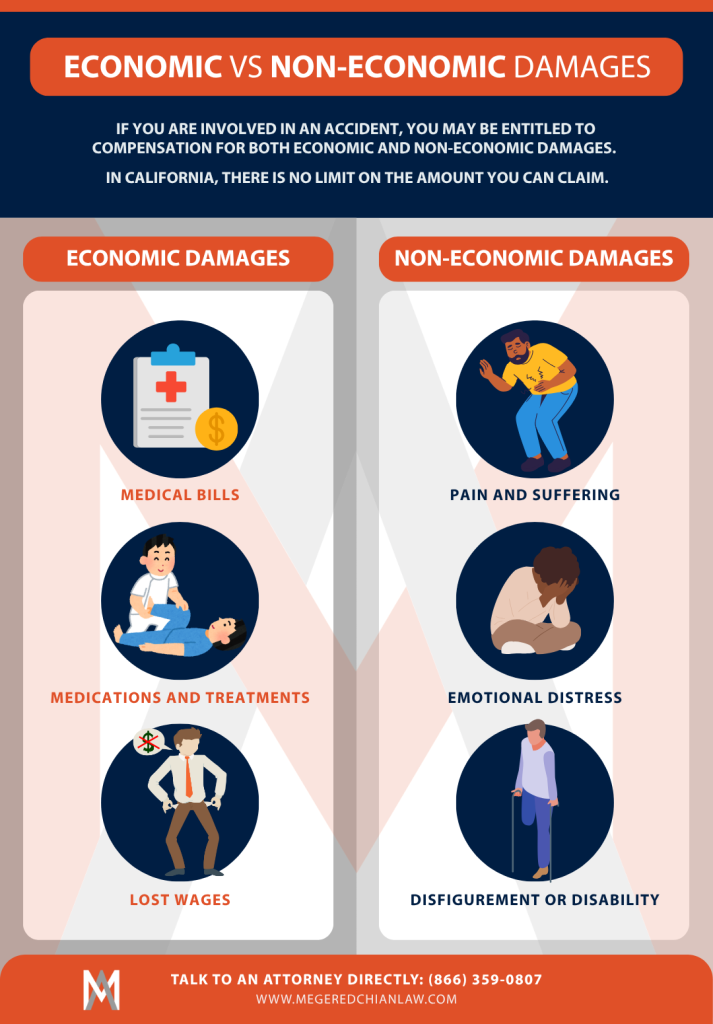
California recognizes two primary categories of damages in rideshare accident claims:
Economic Damages
Economic damages reimburse accident victims for measurable financial losses related to the crash, including:
- Emergency medical care, hospitalization, surgery, physical therapy, and future medical treatment
- Prescription medications, assistive devices, and ongoing rehabilitation
- Vehicle repair or replacement and other property damage
- Lost wages due to missed work
- Loss of future earning capacity if injuries cause long-term or permanent limitations
Non-Economic Damages
Non-economic damages address the personal and emotional impact of an accident, such as:
- Physical pain and ongoing discomfort
- Emotional distress, anxiety, depression, or trauma
- Permanent disability or loss of physical function
- Scarring or permanent disfigurement
- Loss of enjoyment of life and inability to participate in normal activities
California law does not impose a cap on damages in standard personal injury cases, including Uber and Lyft accidents. If a claim goes to trial, a jury may award any amount they believe is reasonable based on the evidence and the extent of the victim’s losses.
What Happens if Someone Dies in an Uber/Lyft Accident?
When an Uber or Lyft accident results in a fatality, California law allows eligible surviving family members to file a wrongful death claim to seek compensation for losses caused by their loved one’s death, including funeral and burial expenses, the loss of financial support the deceased would have provided, and the loss of love, companionship, comfort, care, and guidance.
Uber Accident Lawsuit in California: What You Need to Know
An Uber accident lawsuit in California typically begins by identifying who was at fault and determining Uber’s level of involvement at the time of the crash. This depends on the driver’s status in the app: whether the driver was offline, logged in and waiting for a ride, or actively transporting a passenger.
California law requires Uber to provide different levels of insurance coverage based on that status, which directly affects the amount of Uber accident compensation available. In many cases, claims are first filed against the at-fault driver’s insurance, but Uber’s commercial policy may apply if coverage is insufficient or if the driver was engaged in a ride.
Unlike standard car accident claims, Uber accident lawsuits often involve multiple insurance carriers, complex liability questions, and aggressive defense tactics. Victims may be entitled to recover medical expenses, lost wages, future earning capacity, pain and suffering, and other damages as part of their Uber accident compensation.
Because Uber classifies drivers as independent contractors, lawsuits rarely target Uber directly unless specific legal exceptions apply. However, Uber’s insurance coverage can still provide substantial compensation when properly pursued through a personal injury claim or lawsuit in California courts by experienced California Uber & Lyft accident lawyers.
How Is a Lyft Accident Lawsuit Different From Uber’s?
A Lyft accident lawsuit is structured very similarly to an Uber accident case, but the insurance policies and coverage limits can differ.
Like Uber, Lyft provides insurance coverage based on the driver’s app status at the time of the crash—offline, logged in and waiting, or actively transporting a passenger.
However, policy terms, coverage triggers, and how aggressively claims are defended may vary between companies. These differences can affect how liability is established and how quickly a claim moves forward, even when the facts of the accident are similar.
Another key distinction is how each company’s insurer evaluates damages and negotiates settlements.
While both rideshare companies rely heavily on third-party insurers, the claims process, documentation requirements, and settlement strategies can differ, which may influence the amount of Uber accident compensation or Lyft-related compensation a victim ultimately recovers.
As a result, even though the legal framework is nearly identical, the outcome of a Lyft accident lawsuit can differ from an Uber case depending on insurance handling, available policy limits, and the specific facts of the accident.
Deadlines to File an Uber or Lyft Lawsuit
In California, strict deadlines apply to Uber and Lyft accident lawsuits, and missing them can permanently bar your claim.
In most cases, you have two years from the date of the accident to file a personal injury lawsuit. If the accident resulted in a wrongful death, the deadline is generally two years from the date of death. These time limits apply regardless of whether the claim involves a rideshare driver, another motorist, or Uber or Lyft’s insurance coverage.
Shorter deadlines may apply in certain situations. If a government entity is involved—such as a crash caused by a dangerous road condition or a city vehicle—you may have as little as six months to file a government claim before pursuing a lawsuit. Additionally, while insurance claims may begin immediately after the accident, negotiating with insurers does not pause or extend the legal deadline.
Remember: filing early helps preserve evidence, secure witness statements, and protect your right to seek full compensation.
How to Determine Liability in a Rideshare Accident
Liability in Uber and Lyft accidents is determined under the same California negligence laws that apply to all motor vehicle collisions.
Fault is based on who acted carelessly and caused the crash. If the rideshare driver caused the accident, they may be responsible for injuries to passengers, pedestrians, cyclists, or other drivers. If another motorist caused the collision, that driver is typically liable.
In some cases, more than one party may share responsibility, and California’s pure comparative fault system allows injured victims to recover compensation even if they were partially at fault, with damages reduced by their percentage of fault.
What makes Uber and Lyft accidents more complex is the role of the rideshare companies’ insurance coverage.
Drivers use their personal vehicles but operate in a commercial capacity when logged into the app. As of 2025 California law, insurance coverage depends on the driver’s app status at the time of the crash: offline, logged in and waiting for a ride, or actively picking up or transporting a passenger. Personal auto insurance may apply when the driver is offline, while Uber or Lyft’s commercial insurance policies may provide liability, uninsured/underinsured motorist, and other coverage when the driver is engaged in rideshare activity.
Determining liability often requires reviewing app records, police reports, vehicle damage, witness statements, and insurance policy terms, especially when multiple insurance companies and shared fault are involved.
Find a Rideshare Accident Lawyer Near You in California
You can find experienced California Uber & Lyft accident lawyers throughout the state. Megeredchian Law serves many cities, towns, and communities across California. We understand the importance of having a qualified rideshare accident lawyer who knows your local area and is available to help you right away. Below is a list of some of our office locations. If you live in California and don’t see your area listed, don’t worry—call us at (866) 359-0807 and we’ll connect you with the closest rideshare accident attorney.
Northern California
Central California
Useful Resources and FAQs for Rideshare Accident Victims
Car Accident Legal Guidance
Uber & Rideshare Accidents
Settlements, Compensation & Damages
Litigation & Legal Process
Deadlines & Legal Limits
Hire Local California Uber & Lyft Accident Lawyers with Proven Experience
Uber and Lyft accident claims can be especially complex—but they are not impossible to win. Hiring experienced California Uber & Lyft accident lawyers can make a significant difference in pursuing maximum compensation. Don’t jeopardize your chances by hiring inexperienced attorneys or attempting to represent yourself. Call Megeredchian Law at (866) 359-0807 to have a proven, results-driven rideshare accident attorney on your side.


 Call Us: